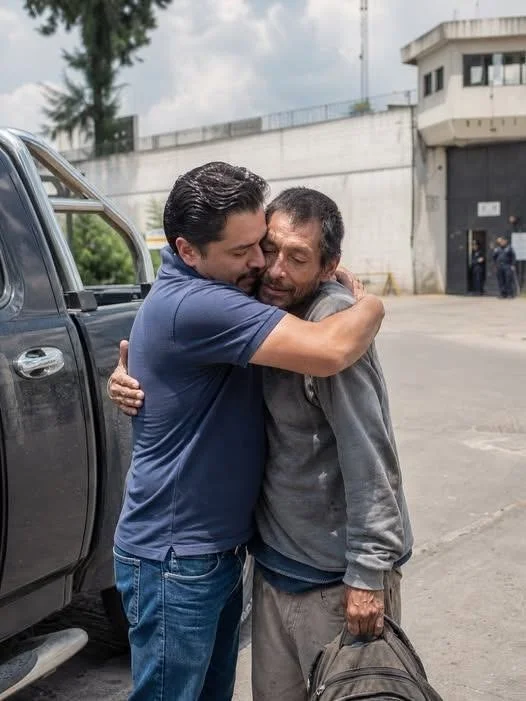
“Does Mom know I’m coming to your house?”
I was silent for a few seconds before answering,
“She knows.” But she didn’t say anything.
The truth was, by then my mother was already too weak. She lived part-time at Tomás’s house and part-time at Mariela’s, and for some time now her voice had carried no weight within the family.
My house was in a quieter area west of Guadalajara. I had managed to build a small business transporting agricultural products between Jalisco and Michoacán. We weren’t millionaires, but we lived comfortably and could give our two children a good school.
But when Esteban walked through the door, I immediately felt the tension in the air.
My wife, Sofía, was standing in the living room. The smile vanished from her face as soon as she saw the man with the old backpack.
“Did you really bring him here?” she asked in a stiff voice.
I replied,
“He has nowhere else to go.”
Sofía looked Esteban up and down and then back at me.
“Diego, our children live here.”
Esteban immediately lowered his head.
“If my sister-in-law isn’t comfortable, I can sleep in the garage for a few days.”
That sentence left a lump in my throat.
I took his small suitcase and brought it inside.
“No one is sleeping in the garage. You’re staying in the room by the patio.”
My children, Mateo and Alma, hid behind me, curiously watching this uncle they only knew a few vague stories about. Esteban sat down, took two cheap mints from his pocket, and timidly offered them to them.
Mateo was the first to accept. Alma looked at her mother before daring to extend her hand.
Sofía said nothing more, but throughout dinner her gaze was as cold as ice.
In the first few days, Esteban lived almost like a shadow. He got up very early, made his bed, swept the patio, fixed the crooked iron gate, changed the lightbulb in the entryway, and then went out to look for work.
But everywhere they looked at his record, those fifteen blank years and his background, they shook their heads.
Three weeks later he came home, his shoulders slumped. I was sitting in the small office behind the house and saw him stand in the doorway for a long time before speaking.
“No one hired you, did they?”
He gave a bitter smile.
“No. Some places said they’d call me. But they probably won’t.”
I glanced at the driver’s uniform of one of my employees, who had just quit and was still hanging there.
“You know how to drive trucks and cars, right?”
Esteban looked up.
“Yes.”
“So, starting tomorrow, you’re going to drive for me.”
He froze.
“Diego, you don’t have to do that.
” “I need someone I can trust. And you need a job. That’s all.”
When Sofia found out, she immediately objected in our room.
“Have you lost your mind? You’re going to hire an ex-convict as your driver? He’s going to transport merchandise, money, even your own children?”
I tried hard to stay calm.
“He’s my brother.
” “And someone who’s been in prison too!
” “He already paid for what he did, Sofia.”
She turned away.
“I just hope the day doesn’t come when you regret it.”
I didn’t answer.
From then on, Esteban started working for me. And what surprised me most was that he did his job more seriously than any of the men I had hired before. He was never late. He checked the vehicle carefully: the tires, the lights, the load. He kept detailed route notes. He treated the customers, the loaders, even people who before wouldn’t have even bothered to look at him, with respect.
Little by little, Mateo and Alma began to grow fond of their uncle. Esteban taught Mateo how to change a tire on a toy car, and Alma showed him how to plant tomatoes in a pot behind the kitchen. Every afternoon, when he returned, they both ran to the entrance to greet him as if they were waiting for someone who had been away for years.
Only Sofía continued to keep her distance.
She no longer said it openly, but her coldness never disappeared. She didn’t like Esteban spending too much time at the table with us, she didn’t like him touching the steering wheel of the family SUV, and she liked it even less that the children were growing more and more fond of him.
And then came the hardest blow, just when she least expected it…
The day my brother was released from prison, the whole turned their backs on him, including my mother, my older brother, and my two sisters. When he had nowhere else to go, only my two children and I opened the for him , despite my wife’s obvious discomfort at seeing him walk through the . I even got him a job as my personal driver… until one day my business collapsed, and he silently took my wife and me to a place that left me speechless. In that very moment, my wife felt ashamed of her own conscience, and I understood that, in this life, family will always be the most important thing.
My name is Diego Ramírez, I was born and raised in an old working-class neighborhood in Guadalajara, Jalisco. The streets around my house were always covered in dust, the walls of the houses faded by the sun, and the ranchera music from the cantina on the corner usually played until well into the night.
My family was never rich, but at least we lived with a certain warmth, until everything fell apart.
My older brother, Esteban Ramírez, was eight years older than me. When I was a child, I saw him as an indestructible wall. He would carry me on his back to cross alleys flooded by the rain, give up his share of tortillas to give to me, and even get into fights with older boys just because they made fun of my worn-out shirt.
But life in the poor neighborhoods of Guadalajara was never easy for an impulsive boy who had to grow up too fast.
When Esteban was twenty-seven, after a night of heavy drinking and a fight in a roadside bar, he seriously injured a man. As a result, he was sentenced to prison.
The day the police took him away, my mother collapsed in the doorway, her hands on her head. My father, a proud man to the core, slammed his fist on the table and muttered:
—From today on, I don’t have a son like him.
My older brother, Tomás, stood with his arms crossed, his gaze frozen, as if Esteban were a stain that had to be erased. My two sisters, Lucía and Mariela, just shook their heads, full of contempt, sighing repeatedly because “the family’s honor had been tarnished.”
And I, at that time, just stood motionless in a corner, watching as the vehicle transporting the prisoners disappeared around the corner.
Seven years later, my father died of a stroke.
Three years later, my mother also began to weaken from diabetes and heart complications. But, strangely enough, even though she had said the cruelest words about Esteban, she still kept an old photograph of him from when he was young in a drawer.
When fifteen years had passed, Esteban was released from prison.
The whole family knew beforehand. But nobody wanted to go and pick him up.
That night, during dinner at my mother’s house, Tomás put his plate down on the table and said coldly:
“Anyone who wants to mess with him, let them. But I’m not going to let someone like that set foot in my house.”
Lucia twisted her mouth disdainfully:
—People like him get out of jail and they’re still the same.
Mariela, while taking a sip of her coffee, added indifferently:
“It’s best if he manages on his own. Any house that takes him in will only bring misfortune.”
My mother remained silent for a long time. Then she asked in a tired voice:
—So, where is she supposed to go?
No one answered.
I looked around the table. People who shared the same blood as Esteban were talking about abandoning him as if he were a broken object.
Then I said:
—If nobody goes for him, I’ll go myself.
Everyone turned to look at me.
Thomas frowned:
—Diego, you have a transport company, a wife, and two children. Don’t bring problems home.
gripped the edge of the chair tightly.
—He’s my brother.
Lucía let out a dry laugh:
—Brother? After fifteen years, he’s nothing but a burden.
I didn’t answer. But the next morning I drove my old pickup truck to the prison on the outskirts of town.
Esteban came out the front wearing faded clothes and carrying an old, worn backpack. He was thinner than I’d imagined, with sunken cheekbones and eyes marked by the years. But when he saw me, he stopped dead in his tracks.
—Did you really… come for me?
I went over and hugged him.
I felt a slight tremor in his shoulders.
During the return trip, Esteban stared out the window for a long time. When we entered the neighborhood, he asked me in a low voice:
—Does Mom know I’m coming to your house?
I remained silent for a few seconds before answering:
—He knows. But he didn’t say anything.
My house was in a quieter area west of Guadalajara. I had managed to build a small business transporting agricultural products between Jalisco and Michoacán. We weren’t millionaires, but we lived comfortably and could afford a good school for our two children.
However, when Esteban crossed the threshold of my house, I immediately felt the atmosphere become tense.
My wife, Sofia, was standing in the living room. The smile vanished from her face as soon as she saw the man with the old backpack.
“Did you really bring him here?” he asked in a rigid voice.
I replied:
—He has nowhere to go.
Sofia looked Esteban up and down and then turned her gaze back to me.
—Diego, our children live here.
Esteban immediately lowered his head.
—If my sister-in-law isn’t comfortable, I can sleep in the garage for a few days.
That sentence left me with a lump in my throat.
I took her small suitcase and brought it inside the
—Nobody’s sleeping in the garage. You’re going to stay in the room next to the patio.
My children, Mateo and Alma, hid behind me, curiously watching this uncle about whom they only knew a few vague stories. Esteban sat down, took two cheap mint candies from his pocket, and timidly offered them to them.
Mateo was the first to accept them. Alma looked at her mother before daring to extend her hand.
Sofia said nothing more, but throughout the entire dinner her gaze was as cold as ice.
In the first few days, Esteban lived almost like a shadow. He would get up very early, make his bed, sweep the yard, fix the crooked iron gate, change the lightbulb in the entrance, and then go out to look for work.
But everywhere they looked at his record, those fifteen blank years and his background, and they shook their heads in denial.
Three weeks later he came home with his shoulders slumped. I was sitting in the small office behind the house and I saw him stand in the doorway for a long time before speaking.
—Nobody hired you, did they?
He gave a bitter smile.
—No. Some places said they would call me. But I’m sure they won’t.
I looked at the chauffeur’s uniform of one of my employees, who had just resigned and was still hanging up.
—You know how to drive trucks and cars, right?
Esteban looked up.
-Yeah.
—Then, starting tomorrow, you’re going to drive for me.
He remained motionless.
—Diego, you don’t have to do that.
—I need someone I can trust. And you need a job. That’s all.
When Sofia found out, she immediately objected in our room.
—Have you gone mad? Are you going to hire an ex-convict as your driver? He’s going to transport merchandise, money, even your own children?
I made an effort to remain calm.
—He’s my brother.
—And also someone who was in jail!
—He already paid for what he did, Sofia.
She turned around.
—I just hope the day doesn’t come when you regret it.
I didn’t answer.
From then on, Esteban started working for me. And what surprised me most was that he took his job more seriously than any of the men I had hired before. He was never late. He checked the vehicle carefully: the tires, the lights, the load. He kept detailed route notes. He treated customers, loaders, and even people who wouldn’t have even bothered to look at him before with respect.
Little by little, Mateo and Alma grew fond of their uncle. Esteban taught Mateo how to change a tire on a toy car, while Alma showed him how to plant tomatoes in a pot behind the stove. Every afternoon, when he returned, the two of them would run to the entrance to greet him as if they were waiting for someone who had been away for years.
Only Sofia continued to keep her distance.
She no longer said it openly, but her coldness never disappeared. She didn’t like Esteban sitting at the table with us for too long, she didn’t like him touching the steering wheel of the SUV , and she liked it even less that the children were growing to love him more and more.
And then came the hardest blow, just when I least expected it…
It all started with a phone call one Monday morning while I was reviewing some papers at the office. One of my main clients, an avocado distributor in Zapopan, had decided to cancel the largest contract my company had ever held. According to him, he’d found a “cheaper and safer” option. I didn’t even have time to react. Two hours later, another client asked to postpone payments. That same week, one of my trucks broke down on the highway to Michoacán, and the merchandise arrived late. I lost money. I lost credibility. I lost sleep.
In less than two months, what had taken me years to build began to crumble like an old wall in the rain.
Debts piled up on my desk. The numbers no longer added up. Employees started asking me, fear in their eyes, if there would be work for the following week. I smiled and said yes, even though inside I felt I was lying.
Atthe atmosphere became heavy.
Sofia started cutting back on expenses without telling me. She stopped buying certain things, turned off lights, and silently reviewed the accounts at night. I would see her sitting at the table with a notebook and a calculator, moving her lips as she did calculations that never added up.
One night, when the children were already asleep, she sat down opposite me and said in a low voice:
—Diego… if this continues, we’re going to lose everything, right?
I didn’t have the courage to lie to him.
I looked down.
-Don’t know.
Her eyes filled with tears, but she didn’t cry. She just nodded, as if deep down she already knew the answer.
During those days, I barely spoke. I left early, came home late, and yet everything seemed to get worse. I called Tomás to ask for a temporary loan. He told me he couldn’t risk money “on a business that was going under.” Lucía offered me unsolicited advice. Mariela didn’t even answer my messages.
Nobody extended their hand.
Nobody, except the man whom everyone had wanted to erase from the
One afternoon I arrived home earlier than usual. My head ached and my chest felt tight. I slumped into a chair in the backyard, staring blankly at the old fence, the flowerpots, the orange sky of Guadalajara.
Esteban came out of the kitchen with a cup of coffee in his hand. He didn’t say anything at first. He just placed it in front of me and sat down next to me.
Several minutes passed before he spoke.
—Things are serious, aren’t they?
I let out a bitter laugh.
—More than you imagine.
He nodded calmly. Then he said:
—Tomorrow morning, I want you to come with me.
I looked at him, tired.
-Where to?
—To a place I need to show you.
I frowned.
—Esteban, I’m not in the mood for riddles right now.
“It’s not a riddle,” he replied, looking me straight in the eye. “Just trust me one more time. Bring Sofia along, too.”
From the kitchen
—And why does he want me to go?
Esteban got up slowly.
—Because they both need to see it.
His tone wasn’t harsh or arrogant. But there was an odd certainty in his voice. Something that made me fall silent.
The next morning, without really understanding why, the three of us got into the truck. Esteban was driving. I was in the passenger seat. Sofia was in the back, silent, looking out the window.
We left the city and took a secondary road surrounded by open fields, prickly pear cacti, small plots of land, and old warehouses. The journey took more than an hour. Neither of us asked any questions after the first few minutes. There was something about Esteban’s face that kept us quiet.
Finally, he turned the truck onto a dirt road and stopped in front of a green-painted iron gate. Beyond it lay a vast expanse of land.
“Get out,” he said.
I did it first. Then Sofia. And as soon as I looked up… I froze.
Before us lay an immense and meticulously tended orchard. Rows upon rows of fruit trees, greenhouses, and fields of tomatoes, chili peppers, squash, and aromatic herbs. Further in, several simple but sturdy buildings stood: a communal kitchen, a storage shed, a small office, and modest, clean dormitories. We saw men working the land, women arranging boxes, and children running along the gravel paths, their laughter pure and genuine.
t was not an abandoned plot of land.
It was no coincidence.
It was a living project. Thriving. Organized.
And at the main entrance, on a white wall, there was a wooden sign:
La Segunda Raíz Community Center
I felt a chill.
“What… what is this place?” I murmured.
Esteban gently closed the truck door.
—It’s the place where I started over.
I turned towards him, not understanding.
At that moment, an older man wearing a palm hat came out of the office and smiled when he saw us.
—Don Esteban! They’ve arrived.
Don Esteban.
Those two words hit me harder than any explanation.
The man approached, shook my brother’s hand with genuine respect, not with pity, not with fear. Respect. Then he greeted Sofia and me.
—You must be his family. Nice to meet you. I’m Julián, the center’s administrator. His brother has told us a lot about you.
I could barely respond.
I looked around again. I saw two young men carrying sacks. One of them had tattoos on his arms and a scar on his eyebrow. The other walked with a slight limp. Further on, a woman with a small child in her arms was washing vegetables while another woman helped her. They all seemed busy, dignified, and serene.
Esteban walked a few steps towards the crops and signaled us to follow him.
“Years ago,” he said, without turning around, “when I got out of prison, I thought my life was worthless. Everywhere I went, doors were closed to me. Nobody wanted to give me a job. Nobody wanted to sit down to eat with me. Nobody trusted me… except you.”
I swallowed.
He continued,
“I started driving for you during the day. But in the evenings, when I finished, I would come here. This land belonged to a parish that had let it fall into disrepair. The priest wanted to make it useful for people who needed a second chance, but he didn’t have enough money or enough hands. One day I offered to help. First, I cleared the weeds. Then I fixed the fences. After that, I planted the first seeds.”
He bent down, took a handful of dirt, and slowly let it fall between his fingers.
“I knew about farming because I helped my grandfather when I was a boy. Remember? Nobody thought it would ever amount to anything. But it did. And when the first harvests came in, they were sold in the nearby markets. With that money, we bought more tools, more seeds, more supplies. Then other men like me started arriving. Ex-convicts. Outcasts. Single mothers. People who had nowhere else to go.”
Sofia put a hand to her mouth.
Esteban looked at her gently, without resentment.
—Here, nobody asks where you come from to humiliate you. They only ask if you’re willing to work and not give up.
My throat felt closed up.
—Did you build all this yourself?
He shook his head slowly.
—Not just me. We built it together. But I have been here from the beginning.
Julian, who had followed us at a distance, intervened:
—Your brother hasn’t just worked here. He was also the one who proposed the distribution system. He was the one who convinced several buyers from Guadalajara to give us a chance. And he was the one who, for years, donated almost his entire salary so that this place could continue to grow.
I turned my face towards Esteban so quickly that I almost felt dizzy.
—What did you say?
Julian smiled sadly.
—He lived on very little. He saved the bare minimum for his personal expenses. The rest came here. He also paid for medical treatments for two children, school supplies, and even helped build the new dormitory wing.
I felt an unbearable heat in my chest.
I remembered every time I had offered him a raise and he had told me it wasn’t necessary. Every time I saw him wearing the same worn jacket, the same patched shoes. I thought it was just the habit of a humble man.
No.
It was renunciation. It was silent generosity.
I turned towards Sofia.
She was pale, with tears in her eyes, looking at Esteban as if she were seeing him for the first time in her life.
Then a girl of about eight years old ran out of the kitchen and hugged my brother’s waist.
—Uncle Esteban, the bread is ready!
He smiled and stroked her hair.
—Very well, Lupita. We’ll be right there.
The girl looked up and watched us curiously before running off again.
Sofia broke down at that moment.
She covered her face with both hands and let out a sob she had been holding back for too long.
“I…” she said through tears. “I was unfair to you.”
Esteban didn’t answer. He waited.