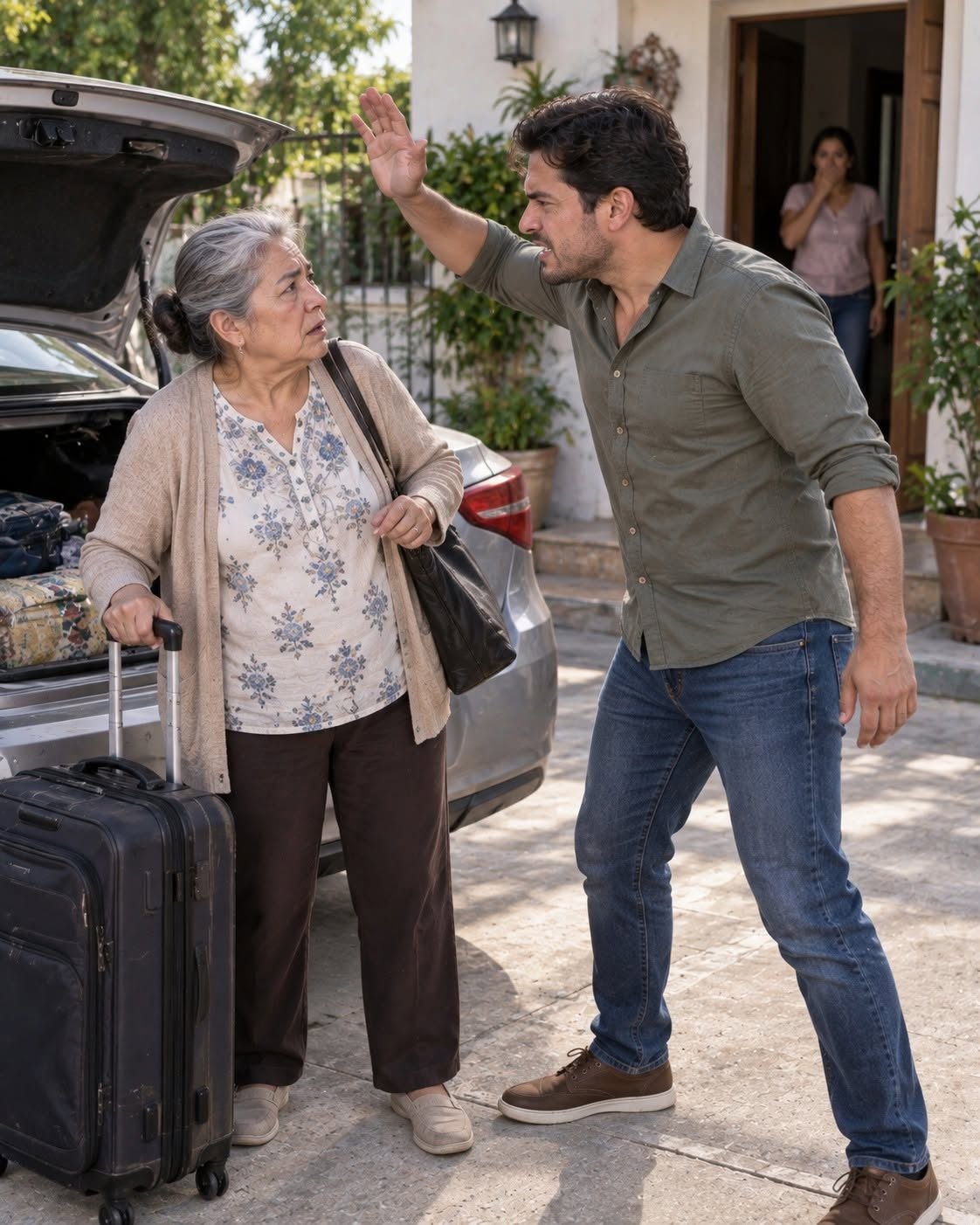
For three years, I lived like a servant in my own home and handed over my savings to my son and daughter-in-law. When I carried my suitcase out to the car, he blurted out, “I didn’t buy you a ticket; this trip is for my family,” and slapped me—at sixty-eight years old. I didn’t cry; instead, I called a lawyer, because I had just realized what he really wanted my house for.
My son Mauricio left me stranded at the entrance of my own home after spending my savings on a vacation he never intended to take me on. I fell sideways onto the stone floor, my cheek burning and my hand scraped. But before shedding a single tear, I understood something that hurt more than the slap: for years, I had confused obedience with love.
Verónica, my daughter-in-law, didn’t even come near me. She just said they would miss their flight. Mauricio loaded the suitcase into the SUV and avoided looking at me.
“Mom, I already told you: the trip is for us and the kids.”
“I paid for the trip.”
“You offered to help.”
“Because you told me we were all going.”
One phrase stuck in my mind: “Don’t start up again.”
Three years earlier, after my husband Arturo died, Mauricio asked if he could stay in my house “for a few months” with Verónica and my grandchildren, Sofía and Mateo. I thought having them close by would be a blessing. But the months turned into years.
First, I gave up my study. Then the garage. Later, I stopped using the dining room because Verónica turned it into an office. I did the cooking, washed school uniforms, picked the kids up from school, and paid almost all the bills, while Mauricio kept saying he would make it all up to me soon.
A year earlier, he had asked for access to my online banking.
“Mom, I’ll handle it.” That way, you don’t have to struggle with passwords or receipts.
It was my son. I believed him.
When a trip to Los Cabos was announced, Verónica showed me photos of the hotel, and the children told me they would swim with me. When Mauricio said it was expensive, I took money from my savings account because I thought it would be a family moment. Now I knew that hug had cost one hundred seventy-six thousand four hundred pesos.
From the floor, I demanded my card and the bank folder. He just smiled and said we would talk when he got back. He got into the SUV, and they drove off.
Ten minutes later, I went into his bedroom. I wasn’t looking for mementos. I was looking for documents.
I found a gray folder with my name on it. Inside were my bank statements, a recent valuation of my house, and emails with a financial advisor I had never met. There was also a draft discussing a supposed geriatric assessment and claiming I needed help managing my assets.
I took photos of everything. Then I saw three transfers to a company called MZ Soluciones Integrales, S. de R.L. de C.V. The payment reference always showed the same word: “regularization.” I had never hired that company.
I called the bank, changed my passwords, and cancelled Mauricio’s additional access. Then I contacted a lawyer, Teresa Ríos.
Her message arrived fifteen minutes later:
“Elena, don’t delete anything, don’t confront your son over the phone, and don’t sign a single document. We’ll meet tomorrow.”
The next morning, my phone started vibrating. Mauricio, Verónica, Mauricio again. Twenty-seven calls from Los Cabos.
Then a message arrived:
“Mom, what did you do with the accounts?”
And another:
“I need you to call me NOW.”
I looked at the screen, and then at the photos from the gray folder. For the first time in three years, the guilt lifted. I grabbed my house keys, put the documents in my bag, and headed out to the meeting with the lawyer.
──────────────────────
Part 2:
She was not luxurious. It had cream-colored walls, a small reception and a plant that seemed to have survived too many winters without water.
But when I crossed that door with the gray folder pressed against my chest, I felt something I hadn’t felt in three years kara.
She wasn’t alone.
Teresa was a woman with short hair and thin glasses. I’d be about fifty. He didn’t receive me with pity or with nice phrases.
He offered me a chair, put a box of handkerchiefs on the table and said,
Tell me what happened, from the beginning. Without minimizing anything.
That was the hardest thing.
Not talking about the slap.
Talk about everything that made it possible.
I told him how Arthur died and how Mauricio came with Veronica and the children saying they only needed time.
I told him about the bills I started paying “for while” from my bank password, the way my opinions became inconvenient within my own home.
The house Is it in her name?” Teresa asked.
“Yes. Arthur and I bought it before Mauricio got married. When he died, he was alone in my name.
Have you ever signed a power, a donation or a co-ownership document?
“No.
Teresa nodded.
“Then no one can sell or administer it without your valid consent.
I handed him the photos of the documents. He checked them one by one.
His expression changed when he arrived at the valuation and the draft geriatric evaluation.
“This is serious.
What does “geriatric evaluation” mean?
Teresa took off her glasses.
“It seems they were trying to build a file to claim that you can’t manage your estate. With that, they could call for judicial support measures or pressure her to sign a
The air turned cold.
Search Houses
“Did you mean I’m disabled?”
They wanted to imply it. It’s not the same, but it may be the first step of a control strategy.
He looked at the transfers again.
Do you recognize this company?
“No.
Teresa wrote the name on her computer. A few minutes passed in silence.
Then he turned the screen to me.
The sole administrator was a man named Mario Zárate.
I didn’t know him.
But below, in the tax domicile, appeared an address that I did know.
It was the apartment where Veronica had lived before marrying Mauritius.
I felt my hands cool.
Is it a company of hers?
“We don’t know for sure yet,” said Teresa. But we do know that three transfers came out of your account to a society related to your political family and that you do not remember having authorized.